The Lunar Eclipse 2026 is one of the most anticipated celestial events of the year for skywatchers across India. A lunar eclipse occurs when the Earth moves directly between the Sun and the Moon, casting its shadow on the Moon’s surface. During a total lunar eclipse, the Moon takes on a stunning reddish glow, often called a Blood Moon, due to the way sunlight bends through Earth’s atmosphere.
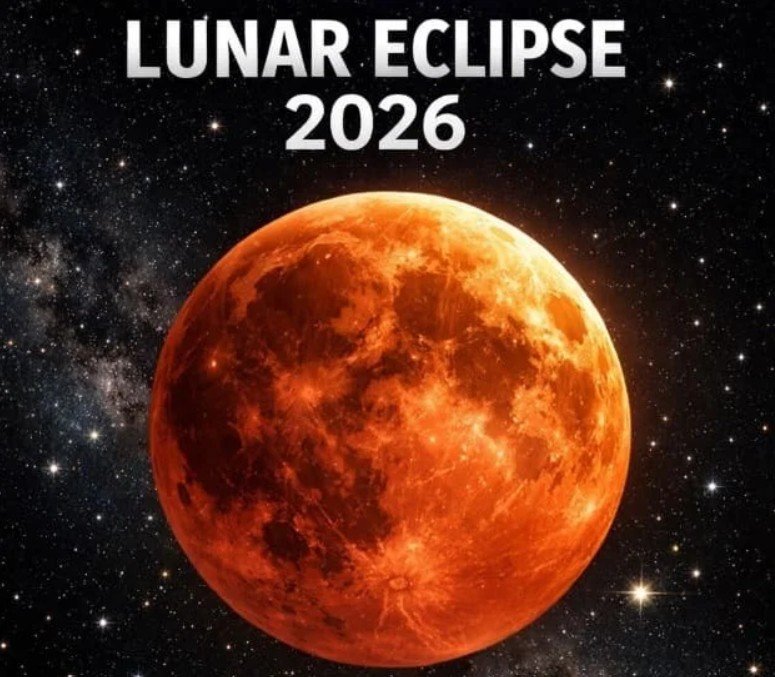
Astronomy enthusiasts, students, and casual observers alike look forward to this rare alignment. Unlike a solar eclipse, a moon eclipse is completely safe to watch with the naked eye. There is no need for special filters or protective glasses. All you need is a clear sky and a good view of the eastern horizon. The March 2026 lunar eclipse promises to offer a remarkable visual experience for viewers in India.
Lunar Eclipse 2026 Date and Timings (IST)
The Lunar Eclipse 2026 in India will take place on 3rd March 2026. Below are the detailed timings in Indian Standard Time (IST):
- Penumbral phase: 2:14 PM – 4:58 PM
- Partial eclipse begins: 3:20 PM
- Total lunar eclipse begins: 4:34 PM
- Maximum eclipse: 5:03 PM
- Total phase ends: 5:32 PM
- Eclipse ends completely: between 6:47 PM and 7:53 PM
The eclipse will begin with the penumbral phase, where the Moon enters Earth’s outer shadow and gradually dims. As the partial lunar eclipse starts at 3:20 PM, a visible dark shadow will appear on the Moon’s surface. The most dramatic moment will occur during the total lunar eclipse phase, starting at 4:34 PM, when the Moon turns coppery-red.
The maximum eclipse at 5:03 PM will be the peak of this astronomical event. After 5:32 PM, the Moon will slowly exit the Earth’s shadow until the eclipse fully concludes in the evening.
What Happens During a Total Lunar Eclipse?
A total lunar eclipse is a fascinating natural phenomenon caused by the alignment of the Sun, Earth, and Moon in a straight line. When the Moon passes completely into Earth’s umbra (the darkest part of the shadow), sunlight filters through Earth’s atmosphere and reflects onto the Moon. This scattering of light gives the Moon its deep red or orange color.
Unlike other astronomical events, a full lunar eclipse can last for several hours, making it easier for observers to witness different stages. From the faint shading of the penumbral phase to the dramatic transformation during totality, each stage has its own charm.
Visibility and Significance of Lunar Eclipse 2026 in India
The March 3, 2026 lunar eclipse will be visible in India during the afternoon and evening hours. Weather conditions will play a key role in how clearly the eclipse can be observed. Areas with clear skies will have the best chance to witness the entire event.
For many, a lunar eclipse is more than just a scientific occurrence. It is an opportunity to observe the wonders of the universe and understand how planetary motion works. Students of astronomy often use such events to study celestial alignment, Earth’s shadow, and the mechanics of the solar system.The Lunar Eclipse 2026 Date and Timings in India offer a perfect chance to step outside, look up, and experience a spectacular display in the sky. Mark your calendar for 3rd March 2026, and don’t miss this extraordinary cosmic event.
